

The Delhi Red Fort blast in November 2025 exposed a sophisticated, foreign-directed terror cell, revealing how DNA evidence became the crucial tool for unmasking its operatives. Led by the codename “Ukasa,” a handler based in Turkey, the cell used doctors as operatives, most prominently Dr Umar Un Nabi, to execute a plot that resulted in tragedy and a major breakthrough for Indian security services.
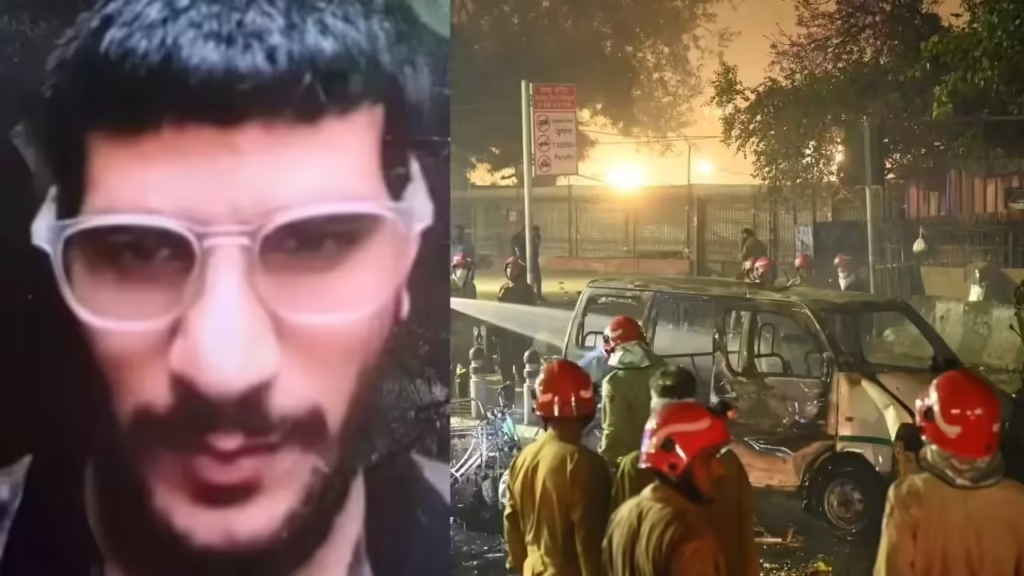
On November 10, 2025, a Hyundai i20 car exploded near Delhi’s iconic Red Fort, killing at least 12 and injuring many others. The shockwave rippled through India, not just from the carnage but from the chilling questions: Who was behind the attack? What larger network enabled it?
DNA Evidence: The Game Changer
In the aftermath, the blast left few clues about the driver’s identity; the explosion had torn apart the driver, rendering regular identification impossible. Investigators quickly gathered forensic remains, including bones, teeth, and fabric scraps from the vehicle. These were matched against DNA samples from family members in Pulwama, Kashmir, home to suspected bomber Dr Umar Un Nabi.
The results were conclusive: DNA evidence from Umar’s remains matched 100% with his mother and brother. This scientific certainty provided the critical breakthrough authorities needed, linking the dead suspect to a larger terror plot and confirming his role beyond any doubt.
The ‘Doctor Module’ and Foreign Handlers
The investigation revealed a “doctor gang”, a module of highly educated professionals, mostly from Al-Falah University, using their status and expertise to mask extremist activities. Central to their operation was communication with an external handler, codenamed ‘Ukasa,’ based in Ankara, Turkey.
‘Ukasa’ orchestrated the group’s movements, finances, and radicalisation, using encrypted messaging platforms like Session and Signal to evade detection. This foreign connection elevated the investigation from domestic terrorism to international conspiracy. Security agencies uncovered that members of the module, including Umar, had travelled from India to Ankara in 2022, cementing the direct involvement of the Turkish handler in strategic planning for their attacks.
Planning the Strikes: Bomber Umar’s 2022 Ankara Trip
Investigators traced serial communications and uncovered that Umar and other operatives visited Turkey in March 2022. During this trip, they likely met Ukasa, received instructions, and learned advanced tactics for covert operations. The trip marked a turning point, not just in operational capability but in the network’s ambition, as plans took shape for multiple synchronised attacks, one notably timed to coincide with the anniversary of the Babri Masjid demolition on December 6.
Evidence and Arrests: Unravelling the Network
Acting on leads from digital devices and chat logs, authorities raided several locations across Jammu & Kashmir, Haryana, and Uttar Pradesh, seizing nearly 3,000 kg of bomb-making materials, including ammonium nitrate, potassium chlorate, and sulphur. Three additional doctors were arrested, with more suspected to be involved.
Diaries recovered from Umar and his close associate, Dr Muzammil, contained coded entries repeatedly referencing “operation,” lending more weight to the theory of an organised multi-pronged terror plot aimed at targeting public spaces and historical landmarks.
The DNA’s Role in Counter-Terror Operations
DNA testing not only confirmed the identity of the bomber but also enabled authorities to reconstruct the module’s structure. It provided irrefutable evidence to counter misinformation and denials, helped link other suspects to the crime via familial matches, and allowed security agencies to zero in on remaining network members hiding in plain sight. Without DNA forensics, the investigation might have stalled, and the terror cell could have regrouped.
Political and Security Response
Once the DNA results were released, the case was transferred to India’s National Investigation Agency (NIA), marking its elevation to the highest priority. Home Minister Amit Shah personally oversaw the early stages of the investigation, and regular reviews were held with intelligence and police leaders to supervise the approach and ensure swift action.
The government’s quick acknowledgement of the Turkish connection sent a message both domestically and abroad: India would aggressively pursue terror networks using foreign handlers, leveraging cutting-edge forensic science and intelligence cooperation.
What the Blast Means for India’s Security Landscape
The Delhi blast had significant implications. It demonstrated:
- The risk posed by “white-collar” terror cells, which utilise educated professionals.
- The ability of international handlers to recruit and direct Indian operatives remotely.
- The decisive role of DNA and forensic science in modern counter-terror operations.
- The urgency of improving digital surveillance and international collaboration to disrupt encrypted communications.
Looking Ahead: Ongoing Investigation
Security agencies continue to pursue leads from Ankara and local sources. Their current priorities are:
- Identifying and arresting all module members, especially those who may have assumed new identities.
- Mapping out the networks maintained by Ukasa, including possible links to Pakistan-based terror groups such as Jaish-e-Mohammed and Ansar Ghazwat-ul-Hind.
- Preventing future attacks by enhancing cooperation with Turkish intelligence and monitoring Indo-Turkish travel involving suspected operatives.